
The Baseline is Broken
The average adult walks fewer than 4,000 steps a day. The standard advice is to 'move more.' But aimless wandering doesn't trigger the physiological stressors needed for cardiovascular adaptation or bone density improvement.
You need intentional mechanics. Cadence. Stride length. Loading. We dissect the anatomy of the step.
Read the Biomechanics Guide →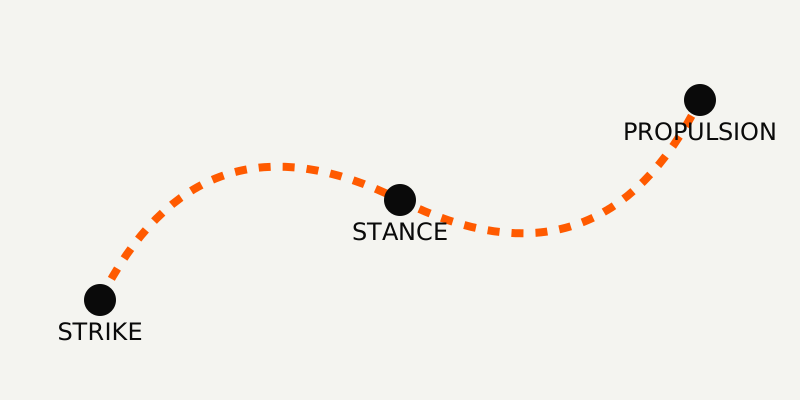
Stop Counting, Start Training
Pace
Walking at 3 mph burns calories. Walking at 4.5 mph completely shifts the metabolic pathway. Understand your pace.
Pace Calculator →Load
Rucking (walking with weight) increases calorie burn by 30-40% and builds postural strength without the impact of running.
Rucking Protocol →Cadence
Steps per minute determines mechanical efficiency. Elite walkers maintain 130+ SPM. Measure your current cadence.
Cadence Tracker →By The
Numbers
Reduction in all-cause mortality
When increasing steps from 4,000 to 8,000 per day. (JAMA, 2020)
Ground Reaction Force
Walking generates forces of 1.2 to 1.5 times body weight per step.
Steps Per Minute
The threshold for moderate-intensity physical activity.
More Energy Expended
Walking on a 5% incline compared to flat ground.
Interactive Tools
The Biomechanical Audit
Your current stride is a product of your environment. Desk jobs shorten hip flexors. Cushioned shoes weaken intrinsic foot muscles. We must audit the machine before we push it.
Pelvic Tilt
Anterior pelvic tilt causes lower back pain during long walks by shutting down the gluteus maximus.
Arm Swing
A rigid upper body increases the metabolic cost of walking by up to 12%. Arms act as counter-pendulums.
Foot Strike
Heavy heel striking transmits shock directly into the knee joint. We aim for a rolling midfoot transition.
Gear is a Tool, Not a Crutch
Footwear Physics
A 12mm heel drop shortens the Achilles over time. A narrow toe box deforms the metatarsals. You don't need 'motion control'—you need space for your foot to function.
Read Gear GuideThe Metabolism of the Walk
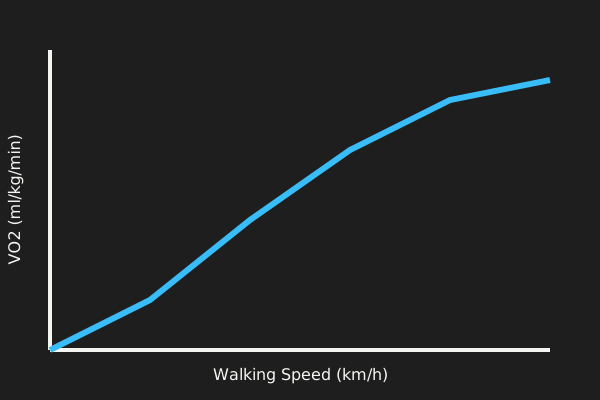
At a low intensity (Zone 1/2), your body relies primarily on fat oxidation for fuel. As pace increases into Zone 3, it shifts toward glycogen. Understanding this curve is critical for fasting and endurance training.
Explore Energy SystemsData Over Dogma
| Metric | Average Adult | Optimal Target | Why it matters |
|---|---|---|---|
| Steps / Day | 3,500 - 4,500 | 8,000+ | Mortality risk reduction plateaus around 8k. |
| Cadence | ~80 SPM | 100 - 130 SPM | Mechanical efficiency and cardiovascular load. |
| Load (Rucking) | 0 lbs | 15-30% Bodyweight | Bone density adaptation via axial loading. |
Stop Wandering. Start Walking.
The tools, the science, and the protocols are here. The execution is up to you.
Take the 30-Day Protocol
Move beyond arbitrary step counts. A structured progression of duration, intensity, and mechanical loading.
View Protocol